What solutions are available to address payment terms?

Category
The LME Law – the French Economic Modernization Law – has regulated payment terms between business partners in France since 2008 and applies to all companies, regardless of their size or industry. Despite numerous government initiatives aimed at reducing payment terms, many companies still struggle to make their payments on time.
As a result of inflation of nearly 6% over the year and the major economic difficulties experienced for more than two years, 45% of business leaders were concerned about maintaining their cash flow for the September 2022 back-to-school period(1).
Financing solutions have been implemented to support companies with their working capital requirements. While nearly one in four business failures is still linked to late payments, various solutions are available on the market to support the French economy.
What does the law say?
Since August 4, 2008, and unless additional provisions are specified in the general terms and conditions of sale (GTCs), French companies are required to pay their supplier(s) within a maximum of 30 days of receiving the invoice relating to the ordered service.
However, exceptions may be provided for if included in the GTCs:
-
Payment may be made immediately, meaning that it is made on the day the service is delivered.
-
Payment may be made upon receipt, i.e. within a period of at least one week following receipt of the invoice.
-
Payment may be made beyond the 30-day period by agreement between the parties: 60 days after the invoice is issued, or 45 days end of month, if stipulated in the contract.
-
Other payment terms may apply to specific business sectors, sometimes allowing the invoice receipt date to be disregarded.
Current situation
Late payments are a real concern. At the beginning of August 2022, the DGCCRF (French Directorate-General for Competition Policy, Consumer Affairs and Fraud Control) announced 138 proceedings in the first half of 2022 for failure to comply with payment terms, compared with 95 in 2021(2).
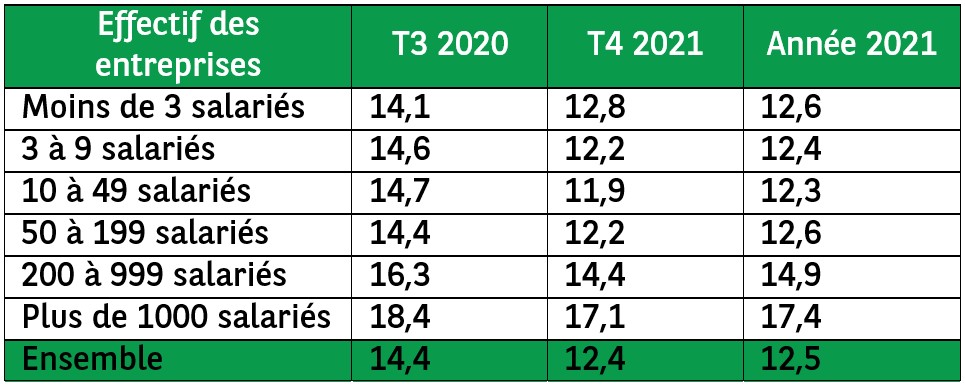
On June 22, 2022, the Observatory of Payment Terms published its 2021 annual report(3). The average payment delay in the same year was 12.5 days.
This figure, which has remained relatively stable, is still higher than the situation before the 2020 crisis.
Payment gaps by company size widened in 2021(4), in connection with the health and economic crisis. The situation remains a concern for smaller companies, which have been more affected than others.
On June 22, 2022, the Observatory of Payment Terms published its 2021 annual report(3). The average payment delay in the same year was 12.5 days.
This figure, which has remained relatively stable, is still higher than the situation before the 2020 crisis.
Payment gaps by company size widened in 2021(4), in connection with the health and economic crisis. The situation remains a concern for smaller companies, which have been more affected than others.
Why is this important?
Beyond the need to comply with the LME Law, late payments have a direct impact on the cash flow of the companies concerned. Indeed, without late payments, SMEs would recover €12 billion in cash, while mid-sized companies (ETIs) would benefit from €4 billion in additional liquidity(5).
Thanks to the Recovery Plan, companies' cash flow was supported over the past two years, but government-backed loans (PGE – Prêts Garantis par l’État) are now due to be repaid.
Faced with late payments, the company holding the receivable may find it difficult to pay its own employees or replenish its supplies if its cash flow is insufficient to cover additional payment delays.
In order to fulfill its orders, the company's working capital requirement will increase.
While most companies affected by late payments cite lengthy payment processes, organizational difficulties or financial difficulties, these delays are most often unintentional.
What solutions are available?
Thanks to the Recovery Plan, companies' cash flow was supported over the past two years, but government-backed loans (PGE – Prêts Garantis par l’État) are now due to be repaid.
Faced with late payments, the company holding the receivable may find it difficult to pay its own employees or replenish its supplies if its cash flow is insufficient to cover additional payment delays.
In order to fulfill its orders, the company's working capital requirement will increase.
While most companies affected by late payments cite lengthy payment processes, organizational difficulties or financial difficulties, these delays are most often unintentional.
Various short-term financing solutions are available on the market to support these companies in their development:
- Bank overdraft facilities, which are widely used to meet short-term cash flow needs.
- Discounting involves a trade receivable held by a company against its customer. In the form of a bill of exchange or draft, it is presented to the bank in exchange for financing. The bill of exchange specifies a payment date and must be accepted, i.e. signed by the debtor customer. To obtain financing, the company must submit the draft, which requires waiting for its return signed by the customer.
- Dailly assignment is a short-term credit facility that allows companies to assign receivables in batches, which the bank finances globally without having to process each receivable individually.
- Factoring enables companies to secure all their B2B transactions(6). The legal difference between Dailly assignment and factoring lies in the legal instrument used to transfer the receivables.
With solutions designed for all types of companies, factors provide:
Invoice financing in less than 24 hours
Protection against non-payment
Payment follow-up and debt collection
BNP Paribas Factor can support your cash flow requirements through factoring.